
“Despite Biden’s pledge to support a two-state solution, cables argue that Palestine should not be granted U.N. member status.
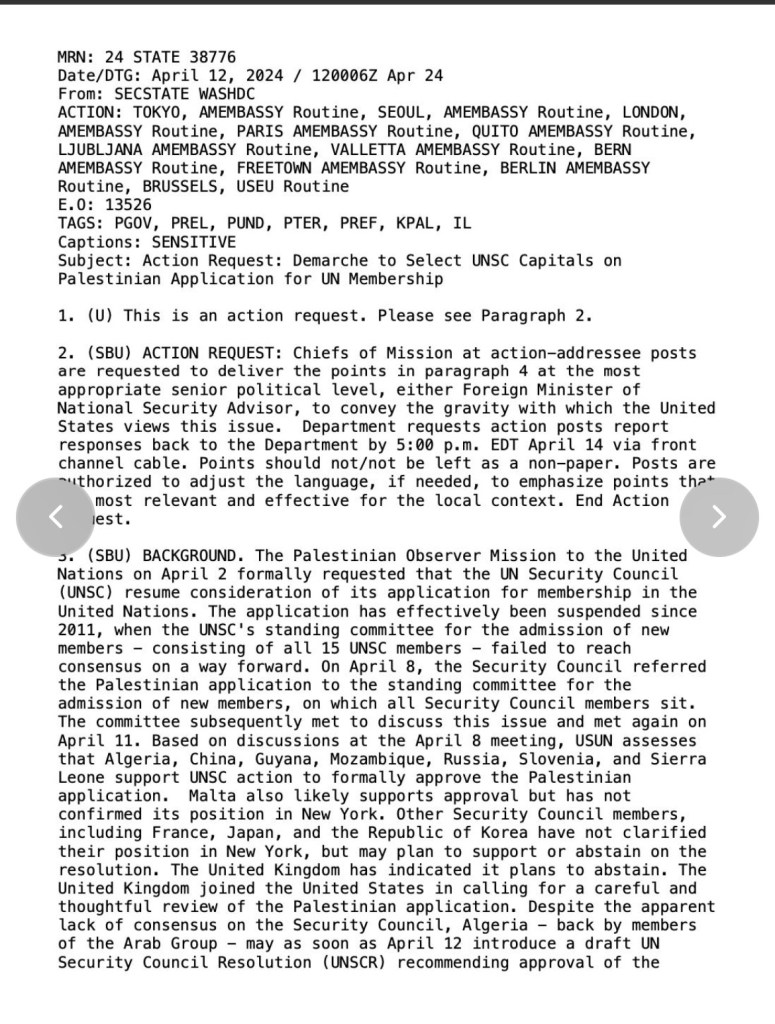
AHEAD OF THE United Nations Security Council action to consider the Palestinian Authority’s application to become a full member of the international body, the United States is lobbying nations to reject such membership, hoping to avoid an overt “veto” by Washington. The lobbying effort, revealed in copies of unclassified State Department cables obtained by The Intercept, is at odds with the Biden administration’s pledge to fully support a two-state solution.
In 2012, the U.N. General Assembly passed a resolution granting Palestine the status of a non-member observer state.

Related Intel Report Warned Abraham Accords Would Fuel Violence
The diplomatic cables detail pressure being applied to members of the Security Council, including Malta, the rotating president of the council this month. Ecuador in particular is being asked to lobby Malta and other nations, including France, to oppose U.N. recognition. The State Department’s justification is that normalizing relations between Israel and Arab states is the fastest and most effective way to achieve an enduring and productive statehood.
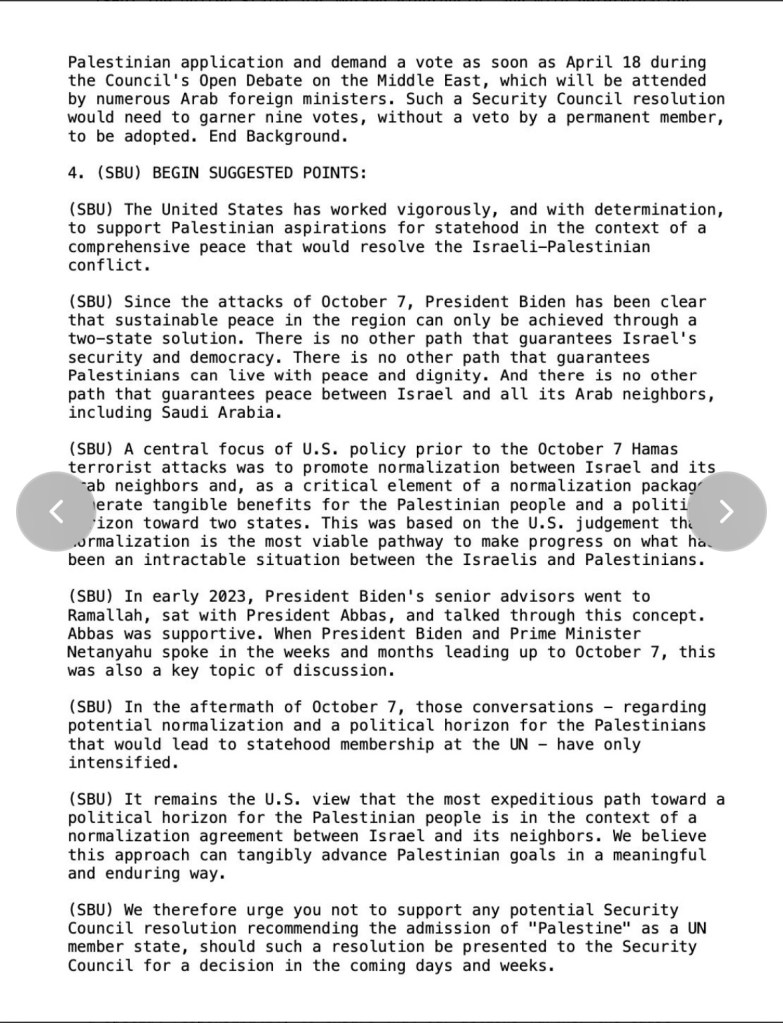
While clarifying that President Joe Biden has worked vigorously to support “Palestinian aspirations for statehood” within the context “of a comprehensive peace that would resolve the Israeli-Palestinian conflict,” a diplomatic cable dated April 12 details U.S. talking points against a U.N. vote for Palestinian statehood. The cable says that Security Council members must be persuaded to reject any proposal for Palestinian statehood — and thereby its recognition as a sovereign nation — before the council’s open debate on the Middle East, scheduled for April 18.
“It remains the U.S. view that the most expeditious path toward a political horizon for the Palestinian people is in the context of a normalization agreement between Israel and its neighbors,” the cable reads. “We believe this approach can tangibly advance Palestinian goals in a meaningful and enduring way.”
“We therefore urge you not to support any potential Security Council resolution recommending the admission of ‘Palestine’ as a U.N. member state, should such a resolution be presented to the Security Council for a decision in the coming days and weeks.”Read Our Complete Coverage Israel’s War on Gaza
Experts say that without a unanimous Security Council vote, any vote from the U.N. General Assembly is largely symbolic.
“Like it or not, a General Assembly vote on this issue is of political rather than legal weight,” Richard Gowan, the International Crisis Group’s U.N. director, told The Intercept. “The Assembly can only accept a new state ‘on the recommendation’ of the Security Council.”
The diplomatic cable includes a rationale for the administration’s opposition to the vote, citing the risk of inflaming tensions, political backlash, and potentially leading to the U.S. Congress cutting U.N. funding.
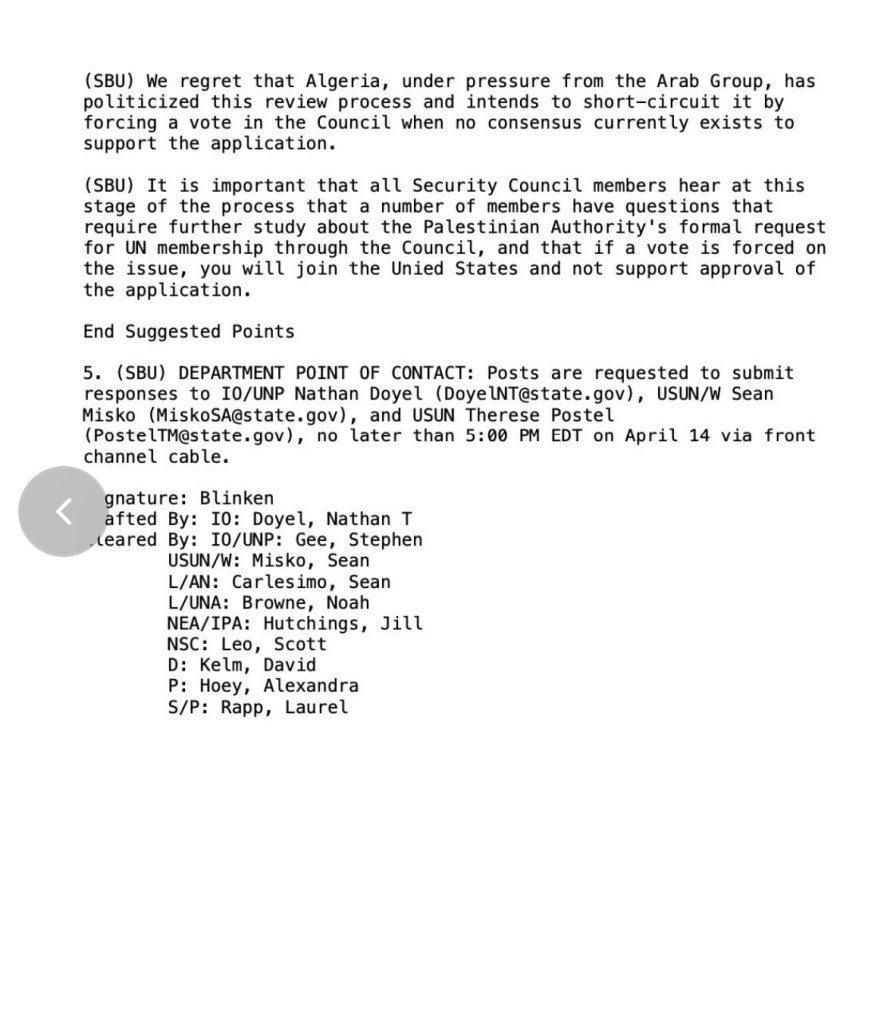
“Premature actions at the UNSC, even with the best intentions, will achieve neither statehood nor self-determination for the Palestinian people. Such initiatives will instead endanger normalization efforts and drive the parties further apart, heighten the risk of violence on the ground that could claim innocent lives on both sides, and risk support for the new, reform government announced by President Abbas,” the cable says.
Asked about the cable and whether its opposition to U.N. recognition of Palestinian statehood contradicts the Biden administration’s position in support of a two-state solution, the State Department did not respond at the time of publication.
“The U.S. position is that the Palestinian state should be based on bilateral agreements between the Israelis and Palestinians,” Gowan said. “It does not believe that the UN can create the state by fiat.””
Copy of First Diplomatic Cable

Copy of Second Diplomatic Cable


Credit: Ken Klipenstein & Daniel Bogustown. Publication: The Intercept. Published: April 17th 2024. Source Link: https://theintercept.com/2024/04/17/united-nations-biden-palestine-statehood/

 T.D.D. News